




For BSc CSIT admission in Nepal, different documents are required. At first, you need to have your Class 11 and Class 12 (or equivalent) mark sheets and transcripts/provisional certificate, a character certificate, citizenship certificate or birth certificate, passport-size photos meeting the MRP standard, migration certificate (if changing boards or universities), an equivalence certificate (for foreign-board students), and the entrance exam admit card and payment voucher. Together, these documents prove your eligibility for the TU IOST entrance exam and, later, for securing your seat at a BSc CSIT college.
Quick Summary: BSc CSIT Documents Checklist
| Category | Documents Needed |
| Academic Records | +2/A-Level marksheets, transcripts, and character certificates |
| Photographs | Recent passport-size photos (usually 4–6 copies) |
| Entrance Exam | entrance admit card, entrance exam scorecard |
| Migration & Equivalence | Migration certificate (if from another board/university), equivalence certificate (for foreign boards) |
| Other | Recommendation letter (some colleges), medical certificate (select colleges), CV (for scholarship applicants) |
1. Academic Documents
These form the core of your BSc CSIT application and prove your eligibility for the program.
- +2 Science Marksheet and Transcript—Original and photocopies of your +2 (or equivalent) mark sheets, showing subject-wise grades.
- +2 Character Certificate / Provisional Certificate — Issued by your +2 school or the board (NEB), confirming conduct and completion.
- Academic Transcript — A detailed record of subjects and credit hours studied, especially important if you’re applying from an A-Level, IB, or foreign curriculum.
- School/College Leaving Certificate (Migration Certificate) — Required if you studied under a different board or university and are switching institutions.
2. Passport-Size Photographs
Most colleges request 4 to 6 recent passport-size photographs (PP size) with a white or light-colored background. Some colleges also require a scanned digital copy for online application portals.
3. Entrance Exam Documents
BSc CSIT admission in Nepal requires clearing the CSIT entrance examination, conducted at the Institute of Science and Technology (IOST), TU. You’ll need to have:
- Entrance Exam Application Form Receipt
- Entrance Exam Admit Card / Roll Number Slip
- Entrance Exam Scorecard—Your official mark sheet showing the entrance rank, required by colleges for final seat confirmation.
4. Equivalence Certificate (For Foreign or Alternative Boards)
If you completed your +2 through A-Levels, IB, or a foreign education board, you’ll likely need an equivalence certificate from the TU Examination Controller’s Office, confirming your qualification is equivalent to the Nepali +2 Science standard.
5. Additional Documents (College-Specific)
Depending on the college, you may also be asked for different documents. But being one of the best bsc csit college in Nepal, Texas International College needs the following documents from students:
- Recommendation Letter — From your previous school (some private colleges request this).
- Medical Fitness Certificate — Not compulsory, occasionally required for hostel or residential admission.
- Statement of Purpose / CV — Mainly required for scholarship or merit-quota applicants.
- Bank Deposit Voucher — Proof of admission fee payment.
Eligibility Criteria for BSc CSIT Admission
Before gathering documents, confirm you meet these baseline requirements:
- One should have completed +2 in the science stream (physics, chemistry, and math compulsory) or equivalent.
- One should have a minimum second division / GPA as prescribed by TU in +2.
- One must have appeared and passed the CSIT entrance exam conducted by IOST, TU.
- Age and other eligibility conditions as specified in the current year’s notice from TU/IOST.
Step-by-Step Document Submission Process
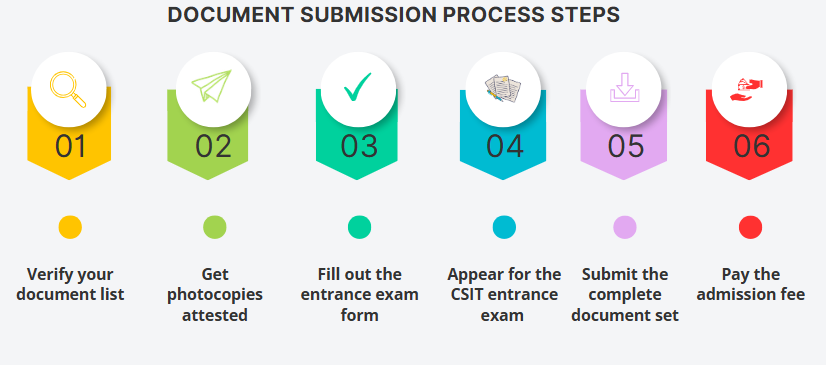
- Verify your document list with your target college, as some private colleges add minor requirements.
- Get photocopies attested
- Fill out the entrance exam form and attach required documents (citizenship, +2 marksheet, photo).
- Appear for the CSIT entrance exam and collect your scorecard online.
- Submit the complete document set to your chosen college during counseling/admission days.
- Pay the admission fee and collect your admission confirmation slip.
Common Mistakes to Avoid
- Don’t submit photocopies without originals for verification, most colleges ask to see originals.
- Don’t forget the migration certificate when switching from a different board.
- Avoid missing the equivalence certificate for A-Level/IB students, which can delay admission by weeks.
- Always keep extra passport photos on hand for last-minute institutional requirements.
Frequently Asked Questions (FAQ)
1. What documents are required for BSc CSIT admission in Nepal?
You must have your +2 marksheet and transcript, character certificate, passport-size photographs, entrance exam scorecard, and if applicable, a migration or equivalence certificate.
2. Is the CSIT entrance exam scorecard mandatory for admission?
Yes. TU requires all BSc CSIT applicants to clear the CSIT entrance exam and a scorecard is mandatory.
3. Do A-Level need extra documents for BSc CSIT?
Yes. Students from A-Level typically need an equivalence certificate from TU’s Examination Controller’s Office as an extra document.
4. How many passport-size photos are needed for BSc CSIT admission?
Most colleges require 4 to 6 recent passport-size photographs, though this can vary slightly by institution.
Note: Document requirements can vary slightly between colleges and change year to year, so always confirm the final checklist directly with your chosen college or the TU/IOST admission notice before applying.